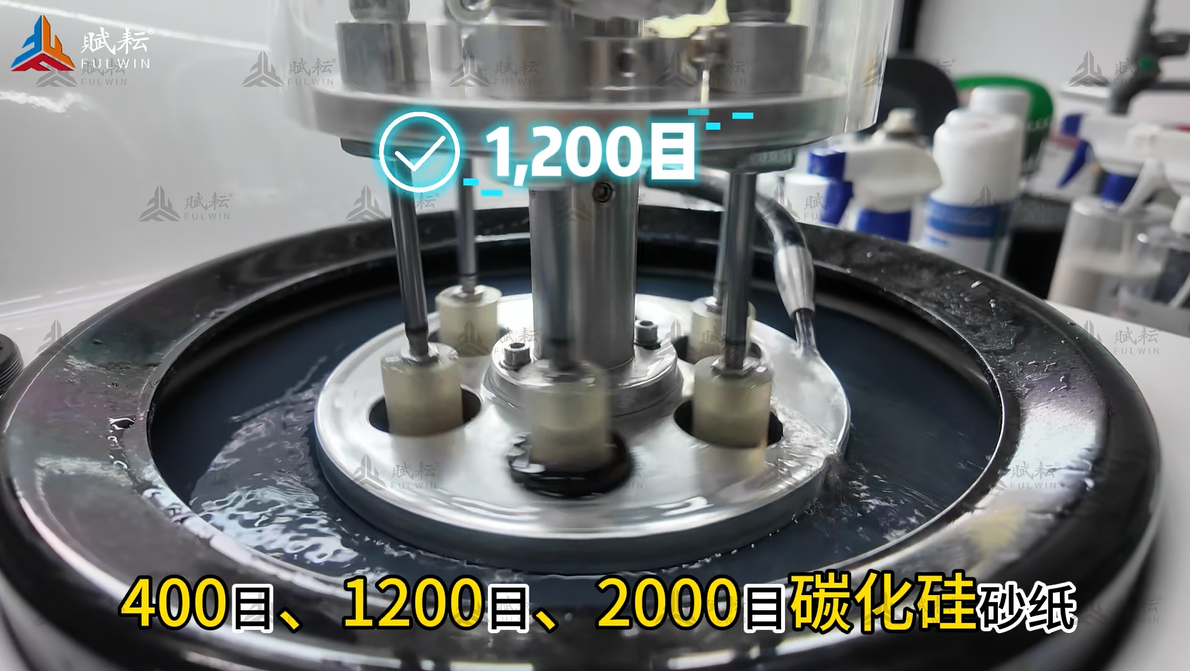
In the whole process of gold-forming, cutting, mosaicing, grinding, grinding, each step of the way is being served for the last - polishing.
Many laboratories have experienced a half-hour grinding, and the last step is due to the incorrect selection of the ointment, the twitching of the particles or the lack of control of the amount, the plastering of the surface of the specimen, and the almost re-entry of the work ahead.
The plaster looks like a little piping, but the size of the particles, the quality of the raw materials and the formula of the carrier directly determines whether your specimen can see a clean tissue under the microscope.
The article speaks no more than three things: what is the plaster of diamonds, how to select the particle size according to the material and demand, and what can be easily pedaled in use.
It's not. Advanced Sandpaper It's the evacuated grinding.
The gold polish is a polished plaster made of finely fined gold, and is used by a plaster polished plaster made of lubricating cooling systems. Its English name is Diamond Polishing Paste, which is usually installed in a syringe-type tube in the gold-shaped laboratory, and is used by a little squeeze on the plating.
The difference between it and sandpaper is that sandpaper is to fix the grinder and cut it on the paper base, and the gold particles in the polish areFreeThe surface of the puddle - they scroll, fine-cut under the rotating pressure, remove the deformation layer of the specimen surface and do not cut out the deeps like a fixed grinder.
So it's particularly good for hard alloy, alloy steel, and high carbon steel. If you take a common silicon oxide polish to throw hard alloy, it's not very efficient; in exchange for a diamond plaster, cutting efficiency and surface quality will increase significantly.
02 The real decision is to polish the effects of these three variables.
Select a diamond-skinned ointment, not by the sound of the sign, but by three hard indicators: the particle-speculation precision, the shape-sizing balance of the grinding material itself, and the smooth cooling performance of the carrier.
First, the particle size determines which part of the polishing process you are in.
The particle size of the ointment of diamonds is marked by micrometres (m) and usually covers the following areas from thick to fine:
Particle size | Shine Phase | Typical uses |
7 μm / 9 μm | Bold polishing | Remove the scratches and deformations. |
3.5 μm / 2.5 μm | Middle polish | And remove the scratches from the gravitational polish. |
1.5 μm / 1 μm | Splash | Get a flat, unstriped view. |
0.5 μm | ♪ And it's all gone ♪ | Final organization of observation, nanoscale surface requirements |
The larger the particle size, the greater the cutting power, the deeper the scratches left; the smaller the particle size, the more light the surface, but the slower the cutting. The normal process must be.Gradient from thick to thinCan't jump.
Second, the size of the particle is not narrow enough to determine a lack of consistency in the scratching.
It's the same. 2.5μm The ointment, some of which are well-selected, is concentrated in a very narrow area, and the surface is evenly thrown; some are rough, mixed with large particles, and there are individual deep cuts that can't be thrown away.
The FuyunDPO series uses fine fine fine fine finely graded fine fine fine powder, with a narrower size and a better size, like a particle, which means that the surface is more consistent with the same ointment.
Third, the vector formulation affects the hand and surface mass.
After the ointment is squeezed on the caster, the carrier does two things at the same time: lubrication, so that the caster and the specimen are not shrouded; cooling, so as to avoid friction of thermal damage to the surface of the specimen. The good carrier formula is thrown down smooth, faceless, and does not corrosive. FuyunDPO series is characterized by: pollution-free, non-color, and process-wise and cooling.
What's in a needle tube?
FuyunDPO has a 10 g syringe-type package. The benefits of this packaging are direct: how many pushes, how much can be controlled, how much can be dug and how much can be dug and how much can not be taken out.
The body of ointment with different physiques is colour-differentiated, and the colour is largely clear from the colour to the finer. The full specification covers from 0.5 to 9 m, essentially covering the whole process requirement of the gold phase from the thick to the final.
In product positioning, it is mainly directed towards grinding and polishing of high-hard materials, such as hard alloy, alloy steel, and high carbon steel. Whether it is manual or mechanical, it is adapted to the requirements of different materials and processes.
The three pits are the most common when used.
Pit one: Spectrum jumps.
It's a little bit of a little bit of a plume, but it's a little bit of a plume. Mozzy. The microscope is all trophied. The correct course is a step-by-step: 9:3.5:1:0.5; each level removes the top-level scratches and then goes down to the lower level.
Pit 2: Use as much as you can.
Squeeze a pile of the canvas to see it throw so fast. In fact, over-mask the plume will leave the plume to rest, and the plume of diamonds will be unevenly distributed, and it will easily cause local over-sliding and surface distortion. Every time the amount of the peas is so big, the dispersion point is enough on the plating.
Pit three: The same plume is mixed in different grains.
The plume is not replaced by a plating cloth, and the finer grain is then pushed. The large particles left in the plume fibres of the plume are then drawn from the plume, and they continue to draw deep marks during the plume phase. The plume, the middle, the plume, the plume, the plume, is suggested to be separated, and at least the plume is cleaned up once the plume is changed.
How do you choose? How do you use it?
Your needs. | Recommended particle size | Operational elements |
Hard-quality alloys, throw them. Remove the scratches. | 7μm / 9μm | Co-op, a little bit of pressure, three to five minutes. |
Alloy steel, throw. Remove the coarse scratch. | 2.5μm / 3.5μm | Switching to medium-plug, medium pressure, and then moving to lower level without visible thick marks on the observation surface. |
Slip it. Get a mirror-level view. | 1μm / 1.5μm | Change the fine-painted, light pressure, and check the surface over and over again in a short time. |
End-of-the-life, nanoscale surface requirements. | 0.5μm | Softest rag, lightest pressure, avoids the tectonic layer from the tumble. |
A simple test: for each change of particle size, the upper one is confirmed under the microscope that the scratches have disappeared completely and then go to the lower one. Almost there. 。
It's at the end.
The plaster is a small waste, but it's at the last step of the process, and it's the quality of all the processes ahead. Cash . Select the particle size, sequentially, and control the amount and plow, and the sample quality will be much more stable.
FuyunDPO series of gold polish, with specifications, direct supply by the manufacturer, and support for custom-made, suitable for stable use in the gold phase laboratories, material testing, and hard alloy processing.
 Official hotline:021-61905265


 Published:2026-10-14
 Views:
 Source: